The Housing Crisis in Southern Oregon: 10 Years of Data on Waiting to Buy
Summer 2021. I sat down with a couple at a coffee shop in Jacksonville. They'd driven up from Sacramento to tour homes, and we'd just walked through a beautiful 3-bed, 2-bath in Central Point with covered patio and views of the Table Rocks. Listed at $430,000. They loved it. You could see it on their faces.
The husband set down his coffee. "Brian, this is insane. Everybody's saying this market is gonna crash. We're gonna wait a year and get the same house for probably $350,000, maybe $375,000."
I told them they might be right. I can't promise prices won't dip. But let's at least talk about what happens if you're wrong.
They called me back this spring. Five years later. Here's what they walked into: the median home in Southern Oregon sold for $436,100 this August. Almost the exact price as that Central Point house they passed on. So they were kind of right about one thing, prices didn't run away from them. That specific house appreciated more than the median, but prices overall didn't go crazy.
But here's what changed. Back then they could have locked in at 3%. Today it's 7.5%. On that same house with 10% down, the principal and interest payment goes from about $1,600 a month to $2,750. An extra $1,150 a month because of the rate difference.
The wife looked at me. "We were so busy trying to time the price that we never even thought about the rate."
They did end up buying, a nice smaller place out in Eagle Point. They're happy. But that $1,100 a month? They're going to feel that for a long, long time.
If you're sitting on the sidelines waiting for rates or prices to come down before you buy here, I pulled 10 years of local market data to show you what waiting has actually cost people. I'm going to walk you through every major community in the Rogue Valley, the real numbers from Jackson and Josephine Counties, and what the math looks like when you compare renting to buying over a decade. No fluff, no steering, just the data and what I've seen happen to real buyers.
Table of Contents
- Central Point: The 2021 Peak Buyer Who Waited
- Eagle Point: Golf Course Living for the Couple Who Hesitated
- Jacksonville: Coffee Shop Conversations and Market Reality
- Ashland: Walkable Downtown Lifestyle
- Rogue River: Garden and Outdoor Living
- Grants Pass: Josephine County Market Context
- Medford Area: 40 Years of Home Price Data
- What 10 Years of Waiting Actually Costs
- Rent vs. Buy: The Full 10-Year Picture
- Conclusion
Central Point: The 2021 Peak Buyer Who Waited
That Central Point home I mentioned, the one with the Table Rocks views, got 7 offers in the first 2 days. That's how 2021 went. You toured on Saturday, it was gone by Sunday. The couple who passed on it thought they were being smart. Wait out the frenzy, let the market cool, come back when things make sense.
Five years later, the median price across both counties is almost identical to what that house listed for. But the payment isn't even close. At 3% in 2021, principal and interest would have been around $1,600 a month. At 7.5% today, it's $2,750. Same house, same street, same kitchen, same view. Just $1,150 more every single month.
Central Point sits right in the middle of the valley with views of the Table Rocks from a lot of the hillside neighborhoods. It's one of those towns where you can still find a 3-bed, 2-bath with a covered patio and some outdoor space without stretching into Ashland or Jacksonville pricing. The couple who waited ended up in a smaller place in Eagle Point instead. They're happy with the golf course access and the community, but they know they gave up square footage and those Table Rocks views they originally wanted.
Here's the thing about waiting in 2021. Everybody had a reason. Bidding wars, waiving inspections, love letters, appraisal gaps. It felt like chaos. And a lot of smart people said the same thing: this has to pop. I heard it dozens of times. But the buyers who closed that summer? They locked in a rate they'll probably never give up, and they've been paying down principal while renters kept writing checks to landlords.
That specific Central Point home appreciated more than the median over those 5 years. I know because I pulled comps on the exact same houses in the exact same neighborhoods, and they held steady even when rates spiked. The median dipped about 4% in early 2023, but that wasn't because homes lost value. It was because buyers were stretching into smaller or older homes to make the payment work. The houses themselves? They didn't drop.
Eagle Point: Golf Course Living for the Couple Who Hesitated
The couple from Sacramento ended up buying in Eagle Point. Smaller than what they originally wanted, but they got access to the golf course and a community that fit their budget after rates climbed. Eagle Point is one of those towns where you can still find homes that don't require you to stretch into the $500,000s or $600,000s, and if you're into golf or just want a quieter spot a little east of Medford, it works.
They're happy. But here's what they gave up by waiting: square footage, the covered patio they wanted, and those Table Rocks views. They also gave up 5 years of equity. If they'd bought in 2021, they'd have about $50,000 to $70,000 in principal paid down by now, plus whatever appreciation that Central Point home saw. Instead, they're starting from zero in 2026 with a payment that's almost $1,200 a month higher.
Eagle Point has that small-town feel with enough amenities that you're not driving to Medford for everything. The golf course is a draw for a lot of retirees and active adults, and you'll see newer construction mixed in with older ranch-style homes. It's not as walkable as Ashland or as historic as Jacksonville, but if you want a little more space and a quieter pace, it's a solid option.
The trade-off for waiting isn't always obvious in the first year. You're renting, you're saving, you're watching the market. But over 5 years, the gap gets wider. The buyer who closed in 2021 has been building equity while the renter has been building nothing. And when rates finally do drop, if they drop, the 2021 buyer can refinance and cut their payment. The person who waited? They're stuck refinancing a higher purchase price.
Jacksonville: Coffee Shop Conversations and Market Reality
Jacksonville is where I sat down with that couple back in 2021. It's one of those towns that feels like it hasn't changed in 50 years, historic downtown, brick buildings, the kind of place where you can walk to coffee and feel like you're somewhere special. It's also one of the pricier spots in the valley, and a lot of buyers use it as a measuring stick for what they can afford elsewhere.
That coffee shop conversation happens all the time. Buyers come through, they love the area, and then they start running the numbers. Jacksonville pricing pushes a lot of people toward Central Point or Medford or even Grants Pass. But the lifestyle here is specific. If you want walkable, historic, and close to wineries and the Britt Festival, you're going to pay for it.
The couple I met with didn't end up in Jacksonville. They couldn't make the numbers work, and honestly, most people can't unless they're coming in with a big down payment or selling a California home. But the conversation we had that day is the same one I have with buyers every week: do you wait for the perfect moment, or do you buy what works now and let time do the heavy lifting?
Jacksonville is also a good example of how this market works over the long term. Homes here don't drop much even when the broader market softens, because inventory is tight and demand is consistent. People who want to live here are willing to pay for it, and that keeps prices stable. If you're waiting for a Jacksonville home to drop 10% or 15%, you're probably going to be waiting a long time.
Ashland: Walkable Downtown Lifestyle
Ashland is the other end of the spectrum from Eagle Point. If you want walking distance to dinner, theater, coffee shops, and a downtown that feels alive year-round, this is the spot. It's also the most expensive town in the valley for a reason. The lifestyle here is specific, and people pay for it.
A 3-bed, 2-bath in Ashland is going to run you significantly more than the same house in Central Point or Rogue River. You're paying for walkability, culture, the Oregon Shakespeare Festival, and a community that skews educated and progressive. If that's your scene, it's worth it. If you're just looking for a place to live and you don't care about walking to dinner, you're probably better off elsewhere.
The buyers who do well in Ashland are the ones who know exactly what they're getting and they're willing to pay for it. The ones who struggle are the ones who fall in love with the town and then try to make the numbers work by stretching their budget or buying something smaller than they wanted. If Ashland is your top choice, make sure the payment fits your budget today, not what you hope it'll be in 2 years.
Ashland also has a rental market that's tight and expensive. A 3-bed, 2-bath rental here is going to cost you more than the valley median, and landlords know they can get it because demand is high. If you're renting in Ashland and waiting for prices to drop, you're paying a premium every month for the privilege of waiting. That adds up fast.
Rogue River: Garden and Outdoor Living
Rogue River is one of those towns that doesn't get talked about as much as Medford or Ashland, but it's a solid option if you want a little more land, a quieter pace, and a lifestyle that leans toward gardening and outdoor living. It's west of Grants Pass, smaller, and you're going to have more space for the money than you would closer to the city centers.
If you're the kind of person who wants to plant a garden and actually see it come in year after year, Rogue River makes sense. You're not paying for walkability or downtown culture. You're paying for space, quiet, and access to the river. The trade-off is you're driving more for shopping, dining, and services. But if that doesn't bother you, it's a good value.
The buyers who end up in Rogue River are usually the ones who know they want a slower pace and they're okay being a little further out. It's not for everyone, but for the right person, it's exactly what they're looking for. And because it's less expensive than Ashland or Jacksonville, it's one of those towns where buying makes more sense than renting if you're planning to stay for 5 or 10 years.
Rogue River also tends to hold value over time because it's not overbuilt and inventory stays relatively tight. You're not going to see the same appreciation spikes as Medford or Ashland, but you're also not going to see the same volatility. It's steady, and for a lot of buyers, steady is exactly what they want.
Grants Pass: Josephine County Market Context
Grants Pass is the biggest city in Josephine County, and it's part of the broader Southern Oregon market that I track alongside Jackson County. The data I'm showing you in this video covers both counties, and Grants Pass makes up a big chunk of the Josephine County side.
Pricing here tends to run a little lower than Medford or Ashland, and you'll find more variety in terms of home styles and neighborhood types. Grants Pass has a reputation for being a little more blue-collar and a little less polished than some of the other valley towns, but it's also got the Rogue River running through it, good access to outdoor recreation, and a cost of living that's more manageable for a lot of buyers.
If you want to dig into specific data for Grants Pass, things like poverty rates, school district info, or census numbers, our website has all of that. Head to buyingSouthernOregon.com, click on Explore the Area, and pick Grants Pass. You'll find loads of information there.
Grants Pass also got recognized by Sunset Magazine recently as one of the top small towns in the West, and Three Rivers Medical Center landed on a national list of top hospitals. Only about 259 hospitals in the country made that list, so that's not nothing. The town is getting more attention, and that tends to bring more buyers, which keeps the market stable even when rates climb.
Medford Area: 40 Years of Home Price Data
Medford is the largest city in the valley and the hub for most of the market activity. When I talk about the Medford area, I'm including the city itself plus the surrounding communities that feed into it, Central Point, Eagle Point, White City, Phoenix. It's where most of the inventory is, and it's where most of the sales happen.
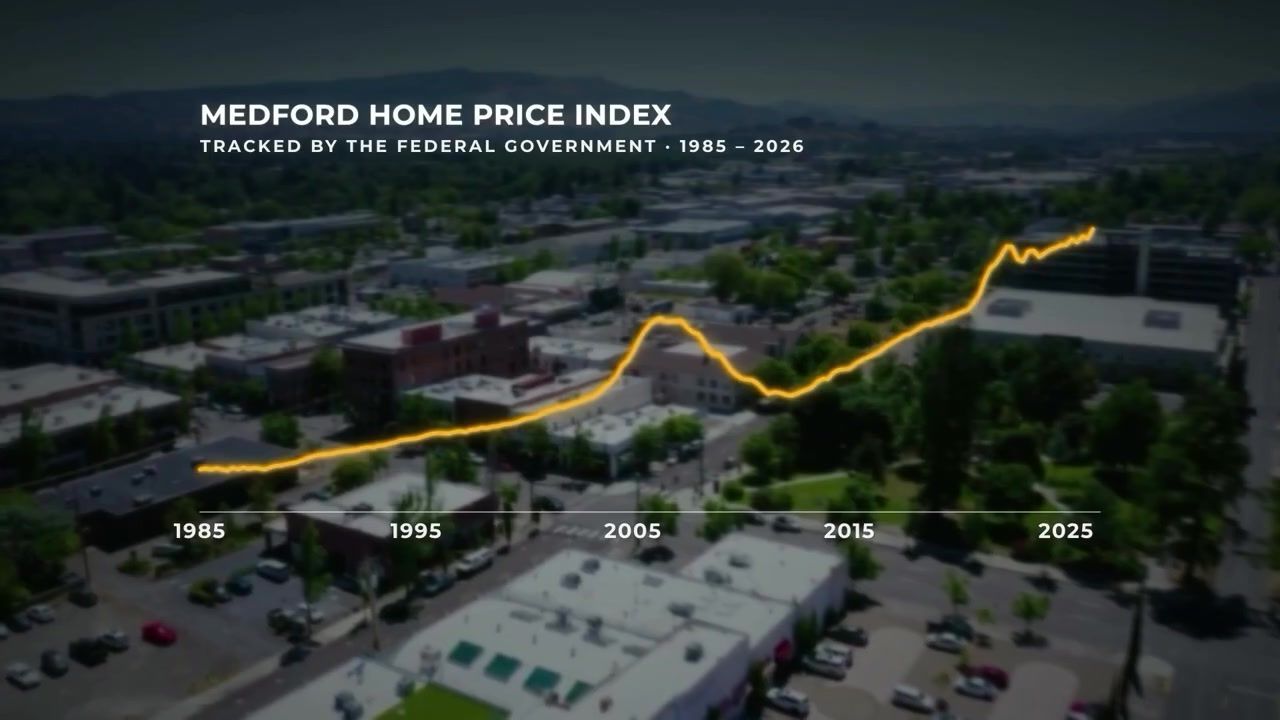
The federal government tracks a home price index for the Medford area going all the way back to the 1980s. I looked at every single 10-year window since 1985, and there are 126 of them. 112 ended higher than they started. The 14 that didn't all had one thing in common: they were people who bought between mid-2004 and the end of 2007, the peak of the subprime bubble.
Back then, people were getting loans without proving their income. Prices ran up way faster than paychecks did, and when that unwound, it hurt. But even those folks, if they held on, the index got back above that 2006 peak by 2019. Today it's close to 50% above it.
Today's buyers are fully documented and well-qualified. It's not the same lending environment as 2006, and the risk of a repeat crash is just not there. The people who do well in this market are the ones who buy a home they'd be happy living in for 10 years and then stop checking Zillow every morning to see how much their home value went up.
Medford also has the most inventory in the valley right now. As I'm recording this, there are about 1,530 homes for sale across both counties. For context, that number was 450 in August 2021. Buyers have way more to choose from now than they've had in years, and that's a big shift from the chaos of 2021 when you toured a house on Saturday and it was gone by Sunday.
What 10 Years of Waiting Actually Costs
Let me show you 3 snapshots 5 years apart: August 2016, August 2021, and August 2026. For each one, picture a buyer who had a perfectly good reason to wait.
August 2016. Median sales price: $270,000. Rates around 3.5%. Inventory under 2 months. Homes selling for about 98.5% of list price, going under contract in 2 to 3 weeks. The reason to wait? Prices had already climbed about 40% off the 2012 bottom. "Prices already went up. I'll wait for them to come back down." The buyer's payment on a median home with 10% down would have been about $1,080 a month.
August 2021. Median sales price: $400,000. Rates under 3%. Inventory about a month. Homes selling at or above list price, in June that year, the average sales price was 101% of asking. Typical home on the market for about a week. The reason to wait? Chaos. Bidding wars on every decent house, people writing love letters, waiving inspections. "This bubble has to pop." The buyer's payment on a median home would have been about $1,600 a month.
August 2026. Median sales price: $436,100. Rates 7.5%. Inventory around 1,530 units. Homes selling for about 98% of list price, taking a little over a month to go under contract. The reason to wait? "Rates are too high." Payment on a median home today: $2,750 a month.
See the pattern? 2016, prices were too high. 2021, the market was too competitive. 2026, rates are too high. All 3 made total sense at the time. And every one of those buyers who waited ended up paying more.
The 2016 buyer who waited 5 years paid $160,000 more for the same house. The 2021 buyer who waited 5 years paid about the same price and over $1,100 more every month because of the rate. Meanwhile, the person who bought in 2016 and just lived their life? They've got about $253,000 in equity right now, a 3.5% rate they're never giving up, and 10 years of paying down their own loan instead of somebody else's.
There's always going to be a reason not to buy. Prices, rates, the election, the economy, what your brother-in-law told you. The buyers who do well out here are the ones who stop trying to pick the perfect month and start thinking in terms of decades.
Rent vs. Buy: The Full 10-Year Picture
Let me run the numbers on the other option people bring up: "Why don't I just rent for a while?" I'm going to show you the whole thing, including the part that doesn't make buying look perfect, because you deserve the full picture.
A 3-bed, 2-bath rental around here runs about $2,250 a month. On the buying side, let's use the median home price of $450,000 with 10% down at 7.5%. First things first: owning costs more in month one. Your principal and interest is about $2,832. Add property taxes, insurance, and money set aside for maintenance, and you're probably at $3,500 to $3,900 a month. Let's call it $3,900 for the math. Versus $2,250 for rent. So you're paying $1,650 more per month to own.
Quick side note on insurance. Oregon is actually one of the least expensive states in the country for homeowners insurance. An analysis this year put Oregon at an average of about $1,100 a year and ranked us 48th most expensive out of 50. The only time you run into issues is when the property is very remote, heavily wooded, or more than 10 miles from a fire station. For a normal home in town or near town, it's a non-issue. I used $1,400 to $1,500 a year in the math just to be conservative.
Now let's run it forward 10 years. I'm going to assume the home only goes up 3% a year, which is lower than the almost 5% we've actually seen here over the last decade. The renter over 10 years pays about $311,000 in rent. They own nothing at the end of it.
The buyer? The home is worth about $605,000. They owe $352,000 on it because they've been paying it down. So they've got roughly $253,000 in equity even after paying a realtor and closing costs to sell. Their principal and interest payment in year 10 is still $2,832, same as day one. The landlord can raise the rent, but the bank can't raise your fixed rate.
Now let's look at what it actually cost each person to live there for 10 years. The buyer put in about $539,000 total, down payment, closing costs, every monthly payment, taxes, insurance, repairs. They walk away with $253,000 in equity. Net cost to live there: about $285,000. The renter spent $311,000 and has nothing to show for it.
If the home appreciates at the pace we've actually had over the last 10 years, almost 5%, then the home is worth about $726,000. The equity is around $375,000, and the buyer's true cost to live there drops to about $169,000. Barely half of what the renter paid.
Now here's the best argument for renting, and I'm not going to hide it. What if you take your down payment that you didn't spend, plus the difference between your rent and what owning would cost, and you invest it every month earning 6% a year? If you actually did that, every dollar, every month, for 10 years, you'd end up with about $340,000. At that conservative 3% appreciation, that beats the buyer's $217,000.
So that is true. But here's the thing. That takes investing $1,600 a month for 120 months in a row, never touching it. Not for a car, not for a trip, not when rents go up. And at today's higher rate, that disciplined investor even edges the buyer at the pace home values have actually grown here, about $346,000 for the renter versus $331,000 for the buyer.
In all my years of doing this, I can count on no hands the number of renters I've met who actually invested the difference every month for a decade. If you know one, let me know. They deserve a pat on the back. It's a great plan on a spreadsheet. Very hard to live in real life.
And that spreadsheet doesn't capture the other stuff. No one's going to sell your house out from underneath you. You can paint the walls. You can plant the garden and still be there when it comes in. That matters when you're trying to build a life somewhere.
Here's my honest take. Buying wins over 10 years in the way that most people actually live their life. If you might move in 2 years, renting might be the smarter call. But if you're planning to stay, the math and the lifestyle both tilt toward buying.
FAQ
What are mortgage rates doing right now in Southern Oregon?
As I'm recording this, Mortgage News Daily has the average 30-year fixed rate over 7.5%, the highest it's been in over a year. Rates dipped under 6% back in February, and everybody got excited. Then they climbed back up a full point in about 7 months. That's the nature of rates, they go up, they go down. Nobody knows where they're going next month or next year.
Is 7% a high mortgage rate historically?
No. If you zoom way out, the average 30-year mortgage rate going back to the early 1970s is 7.7%. The rate everybody's complaining about today is just below the long-term average. The years like 2020 and 2021 when rates bottomed out under 3% were anomalies. That was a Black Friday doorbuster sale of mortgage rates, and it's not coming back anytime soon. Plan your life around 7% being normal.
How much have home prices gone up in Southern Oregon over the last 10 years?
From August 2016 to August 2026, the median sales price went from $270,000 to $436,100. That's a 61% increase, or about 5% a year compounded annually for 10 straight years. And that includes the biggest rate shock in about 40 years, when rates went from under 3% in 2021 to almost 7% in 2023.
Did home prices drop when rates spiked in 2022 and 2023?
The median dipped about 4% from early 2022 to early 2023, but that wasn't because homes lost value. Sales volume dropped by about a third, and a lot of buyers bought smaller or older homes to make the payment work. That pulls the median down. I pulled comps on the exact same houses in the exact same neighborhoods, and they held steady. The homes themselves didn't drop.
How long does it take to see appreciation when you buy a home here?
Every 5-year window in my dataset showed appreciation. The worst case, somebody who bought in August 2021 at the absolute peak, is still up about 1.5% after 5 years. And that buyer has 5 years of principal paid down and a rate under 3% they're probably never giving up. Time is what does the heavy lifting. Your job is to live in the house and let it happen.
Should I wait for rates to drop before I buy?
You can refinance rate, but you can never refinance the price you paid for the house. If you buy today at 7.5% and rates drop to 6.5% next year, you can refinance and cut your payment by $400 a month or more. But if you wait and the home goes up 3% or 4% in value, you're paying more for the same house and you've lost a year of equity. This spring when rates dipped under 6%, the median sales price hit the highest spring median in the entire 10-year dataset. Waiting for a lower rate usually means waiting for more competition.
Conclusion
The Rogue Valley was built on pear orchards. Anybody who's ever planted a pear tree will tell you that you don't get fruit the first year. You don't get it the second year either. You plant it, you water it, and the fruit shows up on its own schedule. Nobody plants an orchard and rips it out after 2 seasons because the fruit hasn't shown up yet.
Buying a home works the same way. The people who get frustrated are the ones who are out there in a year or 2 staring at the branches, wondering why nothing's happening. The people who do well are the ones who buy a home they'd be happy living in for 10 years, make sure the payment works for their budget today, and then stop checking Zillow every morning.
Saturday mornings at the Growers Market with your coffee in your hand. Summer evenings on the patio watching the sun go down behind the hills. Floating the Rogue River on a hot afternoon. Walking through the vineyards in the fall. Those are the things you'll actually remember over the next 10 years. The rate you locked in? You'll probably forget about it the day you refinance.
If you want to walk through what a 10-year plan looks like for you, what you'd qualify for now, which towns fit your budget and your lifestyle, whether now makes sense or maybe later makes sense, call me, text me, or email me. I'd be more than happy to chat with you and give you an honest opinion either way. No sales pitch. Just a straight conversation about what makes sense for your situation.
Rates go up and down. Prices go up and down a little. But over 10 years in Southern Oregon, the people who bought a home they loved and just lived their life came out ahead. Whether they bought when prices felt high, when the market felt crazy, or when rates felt painful. The orchards that built this valley didn't come from the people who planted a tree and gave up after 2 seasons. And that's the same approach I'd take if I were buying a home here.
I'm Brian Simmons with the Buying Southern Oregon team. We've helped hundreds of people relocate to this valley, and we do it as a full one-stop shop, buying, selling, refinancing, lending, all of it under one roof. Reach out anytime, call 541-954-7758 or brian@buyingsouthernoregon.com. And grab that free relocation guide at buyingSouthernOregon.com. It breaks down every major community in both counties, including price ranges and who tends to love each one.

Buying Southern Oregon
At Buying Southern Oregon, we are a dynamic team dedicated to helping you achieve your real estate goals. Combining Brian Simmons’ deep market expertise and Josh Berman’s strong negotiation skills, we provide personalized service and local knowledge to ensure a seamless and rewarding experience. Whether you’re buying, selling, or relocating, we’re here to guide you every step of the way and make your Southern Oregon real estate journey a success.
Watch Our Latest Video